Pediatric Tuberculous Osteomyelitis of the Hip Managed with an Antibiotic-Loaded Cement Spacer Fabricated Using a 3D-Printed Mold: A Case Report
DOI:
https://doi.org/10.56929/jseaortho-2026-0323Keywords:
Pediatric osteomyelitis, Tuberculous osteomyelitis, Hip joint, Antibiotic cement spacer, Three-dimensional printingAbstract
Purpose: To describe a pediatric case of advanced tuberculous osteomyelitis of the hip managed with an antibiotic-loaded cement spacer fabricated using a three-dimensional (3D)-printed mold.
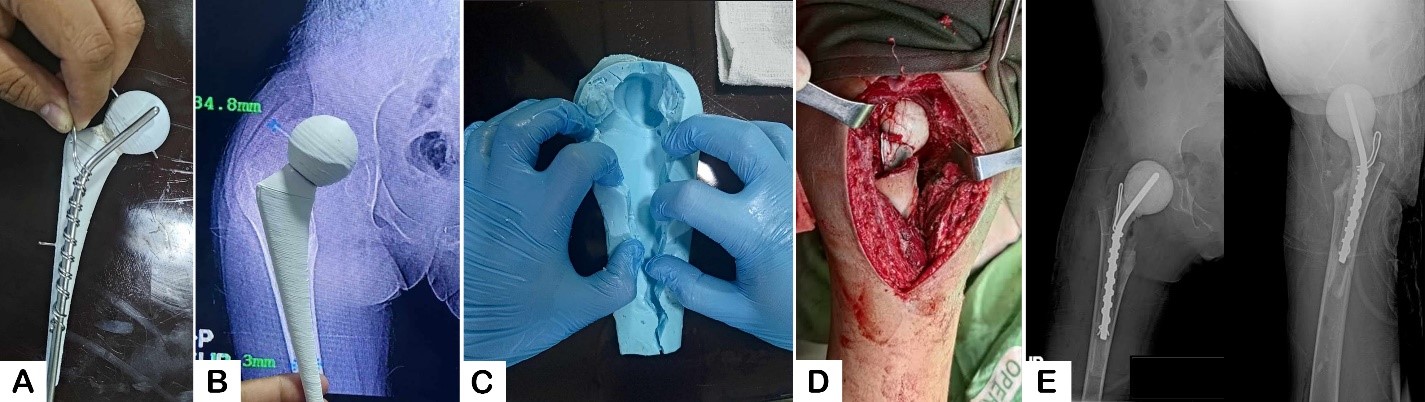
Methods: An 11-year-old child patient with a 2-year history of progressive hip pain, draining sinus formation, and inability to bear weight underwent staged surgical management, including debridement, sequestrectomy, and Girdlestone procedure. Radiographs demonstrated extensive proximal femoral osteolysis with superolateral displacement of the femoral head. Initial microbiologic studies were negative for Mycobacterium tuberculosis, while blood cultures grew Burkholderia cepacia. Histopathology later demonstrated caseating granulomatous inflammation consistent with tuberculosis. A patient-specific antibiotic-loaded cement spacer was fabricated using a 3D-printed mold based on contralateral hip measurements and implanted during the second-stage procedure.
Results: The patient initially showed clinical improvement, with reduced pain and decreased inflammatory markers. At 2 months, spacer displacement was noted, which was associated with poor functional outcomes (Harris Hip Score, 15.19). Long-term follow-up of the patient was not completed.
Conclusions: Customized spacer fabrication using 3D printing is feasible for pediatric patients with hip infections. However, outcomes may be limited in patients with advanced disease. Careful patient selection and follow-up are essential.
Metrics
References
Ballard DH, Tappa K, Boyer CJ, et al. Antibiotics in 3D-printed implants, instruments and materials: benefits, challenges and future directions. J 3D Print Med 2019;3:83-93. DOI: https://doi.org/10.2217/3dp-2019-0007
Canavese F, Corradin M, Khan A, et al. Successful treatment of chronic osteomyelitis in children with debridement, antibiotic-laden cement spacer and bone graft substitute. Eur J Orthop Surg Traumatol 2017;27:221-8. DOI: https://doi.org/10.1007/s00590-016-1859-7
Castellazzi L, Mantero M, Esposito S. Update on the management of pediatric acute osteomyelitis and septic arthritis. Int J Mol Sci 2016;17:855. DOI: https://doi.org/10.3390/ijms17060855
Chang CH, Hu CC, Chang Y, et al. Two-stage revision arthroplasty for Mycobacterium tuberculosis periprosthetic joint infection: an outcome analysis. PLoS One 2018;13:e0203585. DOI: https://doi.org/10.1371/journal.pone.0203585
Chiappini E, Camposampiero C, Lazzeri S, et al. Epidemiology and management of acute haematogenous osteomyelitis in a tertiary paediatric center. Int J Environ Res Public Health 2017;14:477. DOI: https://doi.org/10.3390/ijerph14050477
Jaramillo D, Dormans JP, Delgado J, et al. Hematogenous osteomyelitis in infants and children: imaging of a changing disease. Radiology 2017;283:629-43. DOI: https://doi.org/10.1148/radiol.2017151929
Le Saux N. Diagnosis and management of acute osteoarticular infections in children. Paediatr Child Health 2018;23:336-43. DOI: https://doi.org/10.1093/pch/pxy049
Moon MS, Kim SS, Lee SR, et al. Tuberculosis of the hip in children: a retrospective analysis. Indian J Orthop 2012;46:191-9. DOI: https://doi.org/10.4103/0019-5413.93686
Paley D, Herzenberg JE. Intramedullary infections treated with antibiotic cement rods: preliminary results in nine cases. J Orthop Trauma 2002;16:723-9. DOI: https://doi.org/10.1097/00005131-200211000-00007
Saavedra-Lozano J, Falup-Pecurariu O, Faust SN, et al. Bone and joint infections. Pediatr Infect Dis J 2017;36:788-99. DOI: https://doi.org/10.1097/INF.0000000000001635
Thakolkaran N, Shetty AK. Acute hematogenous osteomyelitis in children. Ochsner J 2019;19:116-22. DOI: https://doi.org/10.31486/toj.18.0138
Zhang H, Zheng S, Liu Q, et al. 3D-printed antibiotic-loaded bone cement spacers as adjunctive therapy for hip periprosthetic infection after arthroplasty: a clinical assessment. Int J Antimicrob Agents 2024;63:107080. DOI: https://doi.org/10.1016/j.ijantimicag.2023.107080
Downloads
Published
How to Cite
Issue
Section
License
Copyright (c) 2026 The Royal College of Orthopaedic Surgeons of Thailand

This work is licensed under a Creative Commons Attribution-NonCommercial 4.0 International License.