Double-Modified Beltawse Reconstruction Using Pedicled Triceps Fascia and Tunneled Polypropylene Augmentation for Late-Presenting Monteggia Lesion
DOI:
https://doi.org/10.56929/jseaortho-2026-0326Keywords:
Radial head instability, Annular ligament reconstruction, Beltawse, Pedicled graft, Elbow instabilityAbstract
Purpose: Chronic radial head instability after missed Monteggia injury remains difficult to treat when soft tissue attenuation compromises stability. This report describes a double-modified Beltawse technique combining pedicled triceps fascia reconstruction with supplemental tunneled polypropylene augmentation.
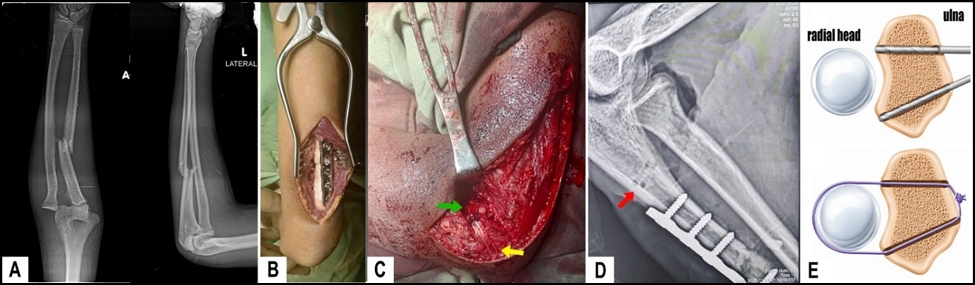
Methods: A 15-year-old male with chronic left radial head instability after a missed Monteggia fracture underwent restoration of ulnar alignment and annular ligament reconstruction. A pedicled triceps fascia strip was used in a modified Beltawse configuration. Because residual radiocapitellar subluxation persisted during intraoperative rotational testing, No. 1 polypropylene augmentation was passed circumferentially around the radial neck and secured through ulnar tunnels.
Results: After augmentation, radiocapitellar congruity was maintained throughout intraoperative flexion–extension and pronation–supination. At 1-month in-person follow-up, the elbow remained clinically stable with maintained radiocapitellar alignment on radiographs. Range of motion improved to 10° to 120° flexion–extension, 70° pronation, and 60° supination. At 7-month follow-up via video consultation, the patient reported no pain, recurrent subluxation, or symptoms suggestive of infection. Visually estimated motion was approximately 5° to 135° flexion–extension, 80° pronation, and 75° supination. DASH score improved from 61 to 12.5, and estimated Mayo Elbow Performance Score was 95. Updated radiographs could not be obtained because the patient was unable to return for in-person radiographic assessment.
Conclusions: This double-modified Beltawse technique provided satisfactory early to mid-term clinical stability in this case. Longer in-person clinical and radiographic follow-up is required to assess durability and late complications.
Metrics
References
Tan L, Li YH, Sun DH, et al. Modified technique for correction of isolated radial head dislocation without apparent ulnar bowing: a retrospective case study. Int J Clin Exp Med 2015;8:18197-202.
Chanlalit C, Kongmalai P. Validation of the telemedicine-based goniometry for measuring elbow range of motion. J Med Assoc Thai 2012;95 Suppl 12:S113-7.
Keijsers R, Zwerus EL, van Lith DRM, et al. Validity and reliability of elbow range of motion measurements using digital photographs, movies, and a goniometry smartphone application. J Healthc Eng 2018;2018:7906875.
Bell Tawse AJ. The treatment of malunited anterior Monteggia fractures in children. J Bone Joint Surg Br 1965;47:718-23.
Langenberg LC, Beumer A, The B, et al. Surgical treatment of chronic anterior radial head dislocations in missed Monteggia lesions in children: a rationale for treatment and pearls and pitfalls of surgery. Shoulder Elbow 2019;12:422-31.
Kim HT, Conjares JNV, Suh JT, et al. Chronic radial head dislocation in children, Part 1: pathologic changes preventing stable reduction and surgical correction. J Pediatr Orthop 2002;22:583-90.
Bhaskar A Missed Monteggia fracture in children: Is annular ligament reconstruction always required? Indian J Orthop 2009;43:389-95.
Downloads
Published
How to Cite
Issue
Section
License
Copyright (c) 2026 The Royal College of Orthopaedic Surgeons of Thailand

This work is licensed under a Creative Commons Attribution-NonCommercial 4.0 International License.