Changes in Flexion and Extension Gaps After Tibial Tubercle Osteotomy and Quadriceps Snip During Total Knee Arthroplasty: A Sequential Cadaveric Study
DOI:
https://doi.org/10.56929/jseaortho-2026-0339Keywords:
tibial tubercle osteotomy, quadriceps snip, flexion gap, extension gap, total knee arthroplasty, extensor mechanismAbstract
Purpose: Quadriceps snip (QS) and tibial tubercle osteotomy (TTO) are extensile exposure techniques used during revision total knee arthroplasty (TKA) and complex primary TKA. We evaluated whether QS and TTO alter intraoperative flexion and extension gaps in a cadaveric TKA model.
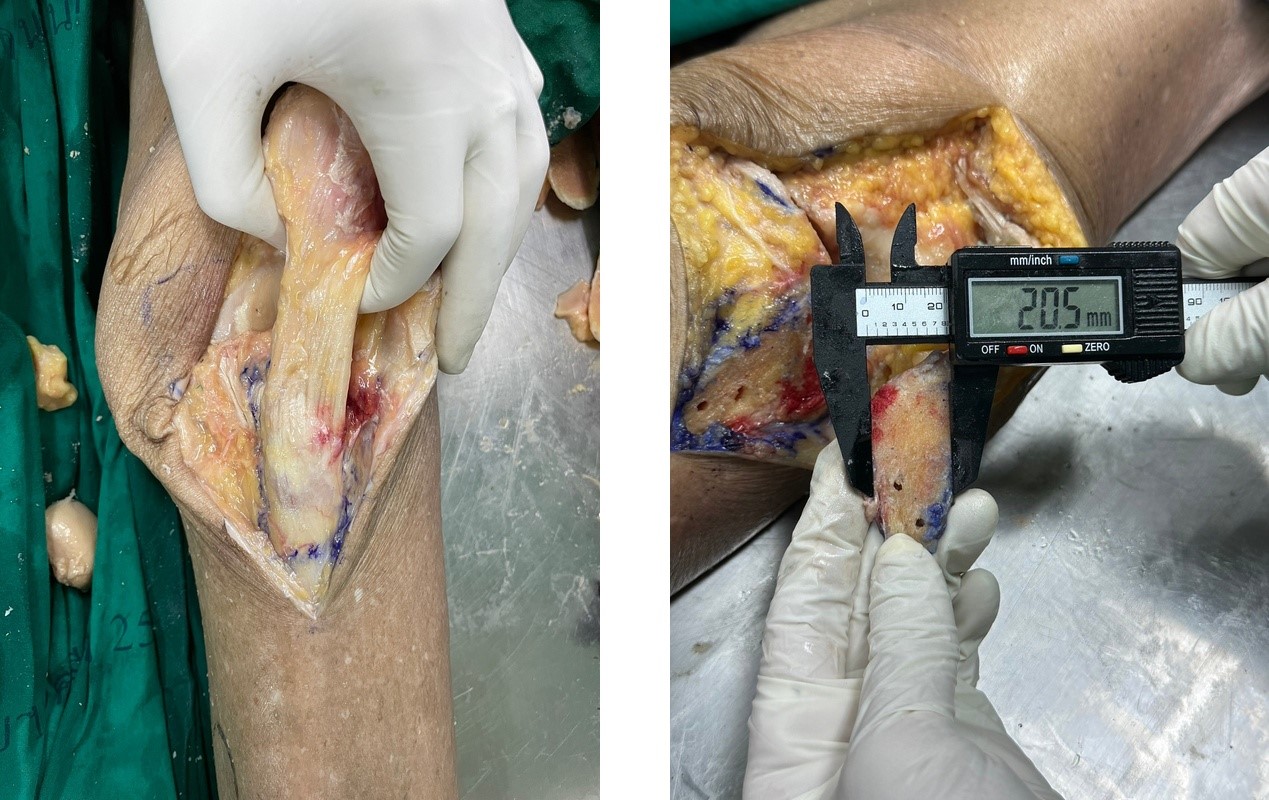
Methods: Six fresh cadaveric knees from three cadavers underwent medial parapatellar exposure and standardized bone resection. The flexion gap at 90° and extension gap at 0° were measured using a tensioning device applying 40 lb (178 N) of force. TTO was performed, and both gaps were remeasured. The tibial tubercle was anatomically fixed, after which QS was performed and the measurements were repeated. This was a sequential within-specimen design with a fixed procedural order. Changes after TTO and QS were compared using paired t-tests.
Results: Mean true flexion and extension gaps were 13.24 ± 3.06 mm and 9.47 ± 1.52 mm, respectively. TTO increased the flexion gap by 3.64 ± 1.48 mm, whereas QS increased it by 1.50 ± 1.13 mm. The mean difference in flexion-gap change was significant (2.14 mm; 95% CI, 0.89 to 3.38; P = 0.007). Extension-gap changes were small: 0.79 ± 1.20 mm after TTO and 0.20 ± 0.67 mm after QS, without a significant difference (0.59 mm; 95% CI, −0.41 to 1.60; P = 0.190).
Conclusions: In this sequential cadaveric TKA model, TTO produced a greater flexion-gap increase than the subsequent QS stage, whereas no significant difference in extension-gap change was detected. The fixed procedural sequence should be considered when interpreting these exploratory findings.
Metrics
References
Della Valle CJ, Berger RA, Rosenberg AG. Surgical exposures in revision total knee arthroplasty. Clin Orthop Relat Res 2006;446:59-68.
Chinzei N, Ishida K, Kuroda R, et al. Tibial tubercle osteotomy with screw fixation for total knee arthroplasty. Orthopedics 2014;37:e367-73.
DeHaan A, Shukla S, Anderson M, et al. Tibial tubercle osteotomy to aid exposure for revision total knee arthroplasty. JBJS Essent Surg Tech 2016;6:e32.
Dolin MG. Osteotomy of the tibial tubercle in total knee replacement. A technical note. J Bone Joint Surg Am 1983;65:704-6.
Garvin KL, Scuderi GR, Insall JN. Evolution of the quadriceps snip. Clin Orthop Relat Res 1995;(321):131-7.
Sun Z, Patil A, Song EK, et al. Comparison of quadriceps snip and tibial tubercle osteotomy in revision for infected total knee arthroplasty. Int Orthop 2015;39:879-85.
Bruni D, Iacono F, Sharma B, et al. Tibial tubercle osteotomy or quadriceps snip in two-stage revision for prosthetic knee infection? A randomized prospective study. Clin Orthop Relat Res 2013;471:1305-18.
Ismailidis P, Kuster MS, Jost B, et al. Clinical outcome of increased flexion gap after total knee arthroplasty: can controlled gap imbalance improve knee flexion? Knee Surg Sports Traumatol Arthrosc 2017;25:1705-11.
Boettner F, Sculco P, Faschingbauer M, et al. Clinical outcome of posterior-stabilized total knee arthroplasty using an increased flexion gap in patients with preoperative stiffness. Bone Joint J 2020;102-B(4):426-33.
Kharwadkar N, Kent RE, Sharara KH, et al. Five to six degrees of distal femoral cut for uncomplicated primary total knee arthroplasty: is it safe? Knee 2006;13:57-60.
Asano H, Muneta T, Hoshino A. Stiffness of soft tissue complex in total knee arthroplasty. Knee Surg Sports Traumatol Arthrosc 2008;16:51-5.
Downloads
Published
How to Cite
Issue
Section
License
Copyright (c) 2026 The Royal College of Orthopaedic Surgeons of Thailand

This work is licensed under a Creative Commons Attribution-NonCommercial 4.0 International License.